Advertisment

Thứ Bảy, 31 tháng 3, 2012

CCNA Discovery 2: DsmbISP Chapter 6 toets antwoorden / DsmbISP answers exam 6


Working at a Small-to-Medium Business or ISP  4.0 English


DsmbISP Chapter 6 Exam Answers

1. Which command is used to view the RIP routing protocol settings and configuration?
• show version
• show ip route
• show interface
• show ip protocols

2.
1
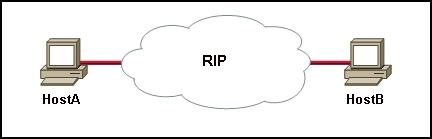
Refer to the exhibit. What is the maximum number of RIP routers that could separate HostA and HostB and still leave the hosts with connectivity to each other?
• 14
• 15
• 16 • 17

3. In which situation would a company register for its own autonomous system number (ASN)?
• when the company's ISP adds connection points to the Internet
• when additional routers are added to the corporate internetwork
• when more than one interior routing protocol is used
• when the company uses two or more ISPs

4. Consider this routing table entry
• R 172.16.1.0/24 [120/1] via 200.1.1.1 00:00:27 Serial0/1
• What type of route is this?
• a static route
• a default route
• a RIP route
• an OSPF route
• an EIGRP route
• a directly-connected route

5. What is the difference between interior and exterior routing protocols?
• Exterior routing protocols are only used by large ISPs. Interior routing protocols are used by small ISPs.
• Interior routing protocols are used to route on the Internet. Exterior routing protocols are used inside organizations.
• Exterior routing protocols are used to administer a single autonomous system. Interior routing protocols are used to administer several domains.
• Interior routing protocols are used to communicate within a single autonomous system. Exterior routing protocols are used to communicate between multiple autonomous systems.

6. What information is included in RIPv2 routing updates that is not included in RIPv1 updates?
• metric
• subnet mask • area identification
• hop count
• autonomous system number

7. Which routing protocol is used to exchange data between two different ISPs?
• BGP
• EIGRP
• OSPF
• RIP v2

8.
2
Refer to the exhibit. Which configuration command or commands contributed to the output that is shown?
• routerA(config-router)# no version 2
• routerA(config)# interface fa0/0
• routerA(config-if)# ip address 172.19.0.0 255.255.0.0
• routerA(config-router)# network 192.168.3.0
• routerA(config)# no ip default-gateway

9.
3
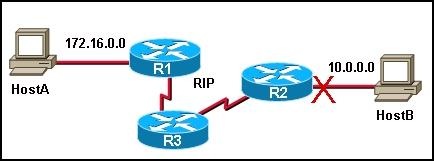
Refer to the exhibit. If all routers are running RIP and network 10.0.0.0 goes down, when will R3 learn that the network is no longer available?
• in 30 seconds
• in 60 seconds
• in 90 seconds
• Immediately

10. What statement is true regarding an AS number?
• AS numbers are controlled and registered for Internet use.
• Interior routing protocols require registered AS numbers.
• ISPs require all customers to have registered AS numbers.
• All routers at an ISP must be assigned the same AS number.

11. What is the purpose of the network command used when configuring RIP?
• to specify whether RIPv1 or RIPv2 will be used as the routing protocol
• to allow the router to monitor RIP updates that occur on other routers
• to identify which networks on the router will send and receive RIP updates
• to configure the IP address on an interface that will use RIP
• to identify all of the remote networks that should be reachable from the router

12. Which command would a network administrator use to determine if the routers in an enterprise have learned about a newly added network?
• router# show ip address
• router# show ip route
• router# show ip networks
• router# show ip interface brief
• router# debug ip protocol
• router# debug rip update

13. What is the purpose of a routing protocol?
• It is used to build and maintain ARP tables.
• It provides a method for segmenting and reassembling data packets.
• It allows an administrator to devise an addressing scheme for the network.
• It allows a router to share information about known networks with other routers.
• It provides a procedure for encoding and decoding data into bits for packet forwarding.

14. What device enables an ISP to connect with other ISPs to transfer data?
• border gateway router
• DSLAM
• web server
• interior router

15. Which command will display RIP routing updates as they are sent and received?
• show ip route
• show ip rip
• debug ip rip
• show ip protocols
• show ip rip database

16. Which part of an IP packet does the router use to make routing decisions?
• source IP address
• source MAC address
• destination IP address
• destination MAC address

17. What two types of businesses would benefit from registering as their own autonomous systems? (Choose two.)
• a home business with one ISP connection
• a global business with connections to multiple local ISPs
• a medium-sized nationwide business with Internet connectivity through different ISPs

• a large enterprise with two connections to the same ISP
• a small ISP with a single Internet connection through a larger ISP

18. Which command will display RIP activity as it occurs on a router?
• debug ip rip
• show ip route
• show ip interface
• show ip protocols
• debug ip rip config
• show ip rip database

19. Why is fast convergence desirable in networks that use dynamic routing protocols?
• Routers will not allow packets to be forwarded until the network has converged.
• Hosts are unable to access their gateway until the network has converged.
• Routers may make incorrect forwarding decisions until the network has converged.
• Routers will not allow configuration changes to be made until the network has converged.

20. Which two statements describe static routes? (Choose two.)
• They are created in interface configuration mode.
• They require manual reconfiguration to accommodate network changes.
• They automatically become the default gateway of the router.
• They are identified in the routing table with the prefix S
• They are automatically updated whenever an interface is reconfigured or shutdown.

21. Which two statements or sets of statements describe differences between link-state and distance vector routing protocols? (Choose two.)
• Link-state routing protocols routinely use more bandwidth for updates than do distance vector routing protocols.
• Distance vector routing protocols update all routers at one time. Link-state routing protocols update one router at a time.
• Link-state routers only know about directly connected routers. Distance vector routers know about every router in the network.
• Link-state routing protocols update when a change is made. A network using distance vector routing protocols only updates at a specific interval.

• Distance vector routing protocols have limited information about the entire network. Link state routing protocols know about all routers in the network.
• In case of similar topologies, networks using link-state routing protocols typically converge more rapidly than do networks using distance vector routing protocols.

22. Which protocol is an exterior routing protocol?
• BGP
• EIGRP
• OSPF
• RIP

23. Hosts on two separate subnets cannot communicate. The network administrator suspects a missing route in one of the routing tables. Which three commands can be used to help troubleshoot Layer 3 connectivity issues? (Choose three.)
• Ping
• show arp
• Traceroute
• show ip route

• show interface
• show cdp neighbor detail

24. What term refers to a group of networks that uses the same internal routing policies and is controlled by a single administrative authority?
• Internet
• intranet
• virtual private network
• autonomous system

CCNA Discovery 2: DsmbISP Chapter 5 toets antwoorden / DsmbISP answers exam 5


Working at a Small-to-Medium Business or ISP  4.0 English


DsmbISP Chapter  5 Exam Answers

1. In what two ways does SDM differ from the IOS CLI? (Choose two.)
• SDM is used for in-band management only. The IOS CLI can be used for in-band and out-of-band management.
• SDM is accessed through a Telnet application. The IOS CLI is accessed through a web browser.
• SDM is available for all router platforms. The IOS CLI is available for a limited number of Cisco devices.
• SDM utilizes GUI buttons and text boxes. The IOS CLI requires the use of text-based commands.
• SDM is used for advanced configuration tasks. The IOS CLI is preferred for initial basic device configuration.

2. Which mode will a configured router display at login?
• global configuration mode
• setup mode
• ROM monitor mode
• user EXEC mode

3.
1
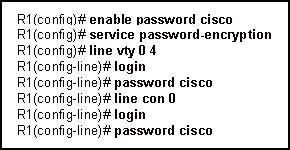
Refer to the exhibit. Which password or passwords will be encrypted as a result of the configuration that is shown?
• virtual terminal only
• enable mode only
• console and virtual terminal only
• enable mode and virtual terminal
• only the service password
• all configured passwords

4.
6
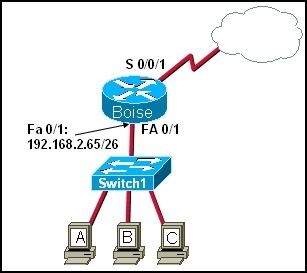
Refer to the exhibit. Which three sets of commands are required to enable administrators to connect to the Switch1 console over Telnet for configuration and management? (Choose three.)
• Switch1(config)# interface fa0/1
   Switch1(config-if)# ip address 192.168.2.64 255.255.255.192
• Switch1(config)# interface fa0/1
   Switch1(config-if)# ip address 192.168.2.66 255.255.255.192
• Switch1(config)# interface vlan 1
   Switch1(config-if)# ip address 192.168.2.126 255.255.255.192
   Switch1(config-if)# no shutdown
• Switch1(config)# line vty 0 4
   Switch1(config-line)# enable password cisco
   Switch1(config-line)# login
• Switch1(config)# line vty 0 15
   Switch1(config-line)# password cisco
   Switch1(config-line)# login
• Switch1(config)# ip default-gateway 192.168.2.65


5. How does the SYST LED on the catalyst 2960 switch indicate a POST failure?
• blinks rapidly amber
• blinks rapidly green
• steady amber
• steady green

6.
5
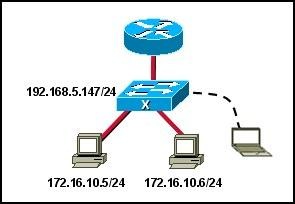
Refer to the exhibit. A company always uses the last valid IP address in a subnetwork as the IP address of the router LAN interface. A network administrator is using a laptop to configure switch X with a default gateway. Assuming that the switch IP address is 192.168.5.147/24, what command will the administrator use to assign a default gateway to the switch?
• X(config)# ip default-gateway 192.168.5.254
• X(config)# ip gateway 192.168.5.1
• X(config)# ip route 0.0.0.0 0.0.0.0 192.168.5.1
• X(config)# ip default-route 192.168.5.1
• X(config)# ip route 192.168.5.254 255.255.255.0 fastethernet 0/0

7. A technician has made changes to the configuration of a router. What command will allow the technician to view the current configuration before he saves the changes?
• router# show running-config
• router# show startup-config
• router# show flash
• router# show version

8. Passwords can be used to restrict access to all or parts of the Cisco IOS. Select the modes and interfaces that can be protected with passwords. (Choose three.)
• VTY interface
• console interface

• Ethernet interface
• secret EXEC mode
• privileged EXEC mode
• router configuration mode

9. To save time, IOS commands may be partially entered and then completed by typing which key or key combination?
• Tab
• Ctrl-P
• Ctrl-N
• Up Arrow
• Right Arrow
• Down Arrow

10. What is the correct command sequence to configure a router host name to 'LAB_A'?
• Router> enable
   Router# configure terminal
   Router(config)# hostname LAB_A

• Router> enable
   Router# hostname LAB_A
• Router> enable
   Router# configure router
   Router(config)# hostname LAB_A
• Router> enable
   Router(config)# host name LAB_A

11.
3
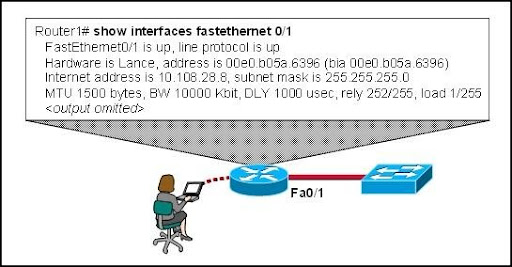
Refer to the exhibit. From the router console, an administrator is unable to ping a Catalyst switch that is located in another building. What can the administrator do from her location to check the IP configuration of the attached switch?
• Open an SDM session with the switch from her desktop.
• Telnet to the switch from the router console.
• Use the show cdp neighbors detail command from the router console.
• The administrator must go to the switch location and make a console connection to check these settings.

12. Which two options must be selected in SDM Express to enable a router serial interface to obtain an IP address automatically? (Choose two.)
• Easy IP (IP negotiated)
• IP unnumbered
• No IP address
• HDLC encapsulation
• Frame Relay encapsulation
• PPP encapsulation

13. What three settings can be made in the SDM Express basic configuration screen? (Choose three.)
• host name
• DHCP options 
• domain name
• interface IP addresses
• enable secret password
• DNS server IP addresses

14. Which tasks can be accomplished by using the command history feature? (Choose two.)
• View a list of commands entered in a previous session.
• Recall up to 15 command lines by default.
• Set the command history buffer size. • Recall previously entered commands.
• Save command lines in a log file for future reference.

15. What option within Cisco SDM Express must be configured to allow hosts that receive IP address settings from the router to resolve names on the network or Internet?
• host name
• domain name
• DHCP address pool
• DNS server IP address
16. Which three encapsulation types can be set on a serial interface by an administrator who is using SDM Express? (Choose three.)
• ATM
• CHAP
• Frame Relay
• HDLC

• PAP
• PPP

17. Which command will display routing table information about all known networks and subnetworks?
• Router# show ip interfaces
• Router# show ip connections
• Router# show ip route
• Router# show ip networks

18. A network administrator needs to configure a router. Which of the following connection methods requires network functionality to be accessible?
• console
• AUX
• Telnet
• modem

19. Which three pieces of information about a neighbor device can be obtained by the show cdp neighbors command? (Choose three.)
• platform
• routing protocol
• connected interface of neighbor device
• device ID

• IP addresses of all interfaces
• enable mode password

20.
2
Which function is a unique responsibility of the DCE devices shown in the exhibit?
• transmission of data
• reception of data
• clocking for the synchronous link
• noise cancellation in transmitted data

21. Which of the following are functions of NVRAM? (Choose two.)
• stores the routing table
• retains contents when power is removed
• stores the startup configuration file

• contains the running configuration file
• stores the ARP table

22.
4
Refer to the exhibit. Which series of commands will enable users who are attached to Router1 to access the remote server?
• Router1(config)# interface S0/0/0
   Router1(config-if)# ip address 64.100.0.129 255.255.255.252
   Router1(config-if)# clock rate 64000
   Router1(config-if)# no shutdown
• Router1(config)# interface S0/0/0
   Router1(config-if)# ip address 64.100.0.125 255.255.255.252
   Router1(config-if)# no shutdown
• Router1(config)# interface S0/0/0
   Router1(config-if)# ip address 64.100.0.125 255.255.255.252
   Router1(config-if)# clock rate 64000
   Router1(config-if)# no shutdown
• Router1(config)# interface S0/0/0
   Router1(config-if)# ip address 64.100.0.129 255.255.255.252
   Router1(config-if)# no shutdown


23. A network technician is attempting to add an older workstation to a Cisco switched LAN. The technician has manually configured the workstation to full-duplex mode in order to enhance the network performance of the workstation. However, when the device is attached to the network, performance degrades and excess collision are detected. What is the cause of this problem?
• The host is configured in a different subnet from the subnet of the switch.
• There is a duplex mismatch between the workstation and switch port.
• The switch port is running at a different speed from the speed of the workstation NIC.
• The host has been configured with a default gateway that is different from that of the switch.

24. Which of the following statements are true regarding the user EXEC mode? (Choose two.)
• All router commands are available.
• Global configuration mode can be accessed by entering the enable command.
• A password can be entered to allow access to other modes.
• Interfaces and routing protocols can be configured.
• Only some aspects of the router configuration can be viewed.

25. Which command turns on a router interface?
• Router(config-if)# enable
• Router(config-if)# no down
• Router(config-if)# s0 active
• Router(config-if)# interface up
• Router(config-if)# no shutdown

CCNA Discovery 2: DsmbISP Chapter 4 toets antwoorden / DsmbISP answers exam 4


Working at a Small-to-Medium Business or ISP  4.0 English


DsmbISP Chapter 4 Exam Answers

1. In an 8 bit binary number, what is the total number of combinations of the eight bits?
• 128
• 254
• 255
• 256
• 512
• 1024

2. Convert the decimal number 231 into its binary equivalent. Select the correct answer from the list below.
• 11110010
• 11011011
• 11110110
• 11100111
• 11100101
• 11101110

3. How many usable hosts are available given a Class C IP address with the default subnet mask?
• 254
• 255
• 256
• 510
• 511
• 512

4. Which statement describes NAT overload or PAT?
• Each internal address is dynamically translated to an individual external IP address.
• A single internal address is always translated to the same unique external IP address.
• Many internal addresses can be translated to a single IP address using different port assignments.
• Many internal addresses are statically assigned a single IP address and port to use for communications.

5. Which IPv4 class of addresses provides the most networks?
• Class A
• Class B
• Class C
• Class D
• Class E

6. Which statement accurately describes public IP addresses?
• Public addresses cannot be used within a private network.
• Public IP addresses must be unique across the entire Internet. • Public addresses can be duplicated only within a local network.
• Public IP addresses are only required to be unique within the local network.
• Network administrators are free to select any public addresses to use for network devices that access the Internet.

7. Which two statements describe classful IP addresses? (Choose two.)
• It is possible to determine which class an address belongs to by reading the first bit.
• The number of bits used to identify the hosts is fixed by the class of the network.
• Only Class A addresses can be represented by high-order bits 100.
• Up to 24 bits can make up the host portion of a Class C address.
• Up to 24 bits can be used to identify unique networks.
• Three of the five classes of addresses are reserved for multicasts and experimental use.

8. Company XYZ uses a network address of 192.168.4.0. It uses the mask of 255.255.255.224 to create subnets. What is the maximum number of usable hosts in each subnet?
• 6
• 14
• 30
• 62

9. hat is the network broadcast address for a Class C address of 192.168.32.0 with the default subnet mask?
• 192.168.0.0
• 192.168.0.255
• 192.168.32.0
• 192.168.32.254
• 192.168.32.255

10.
1
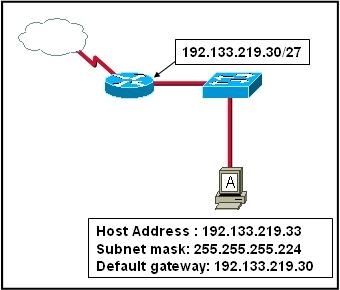
Refer to the exhibit. Host A is connected to the LAN, but it cannot get access to any resources on the Internet. The configuration of the host is shown in the exhibit. What could be the cause of the problem?
• The host subnet mask is incorrect.
• The default gateway is a network address.
• The default gateway is a broadcast address.
• The default gateway is on a different subnet from the host.

11. IPv6 increases the IP address size from 32 bits to how many bits?
• 64
• 96
• 128
• 192
• 256
• 512

12. What is the range of the first octet in a Class B address?
• 127 to 191
• 127 to 192
• 128 to 191
• 128 to 192

13. Which IPv4 class provides the highest number of host addresses per network?
• Class A
• Class B
• Class C
• Class D
• Class E

14.
2
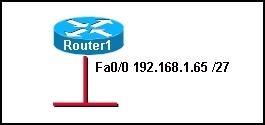
refer to the exhibit. Which range of IP addresses would allow hosts that are connected to the Router1 Fa0/0 interface to access outside networks?
• 192.168.1.0 through 192.168.1.95
• 192.168.1.66 through 192.168.1.94
• 192.168.1.66 through 192.168.1.96
• 192.168.1.0 through 192.168.1.127
• 192.168.1.66 through 192.168.1.128

15. Which option shows the proper notation for an IPv6 address?
• 2001,0db8,3c55,0015,abcd,ff13
• 2001-0db8-3c55-0015-abcd-ff13
• 2001.0db8.3c55.0015.abcd.ff13
• 2001:0db8:3c55:0015::abcd:ff13

16. What are two reasons that NAT was developed? (Choose two.)
• to preserve registered public IP addresses
• to allow users on the public Internet to access local networks
• to provide a method for privately addressed LANs to participate in the Internet
• to make routing protocols operate more efficiently
• to allow private addresses to be routed on the public Internet
• to reduce overhead and CPU usage on gateway routers

17. What must happen for a privately addressed host on an inside local network to be able to communicate with an outside destination host on the Internet?
• The host IP address must be translated to an outside private address.
• The host IP address must be translated to an inside local address.
• The host IP address must be translated to an outside local address.
• The host IP address must be translated to an inside global address.
18. Which port numbers are used by PAT to create unique global addresses?
• 255 and below
• 1024 and below
• 1025 and above
• 64,000 and above

19. Static NAT works by mapping a specific inside local IP address to what other specific address type?
• inside global
• outside local
• outside global
• private IP address

20. What are three advantages of NAT implementations? (Choose three.)
• improved security
• improved router performance
• decreased processor load
• improved scalability
• universal application compatibility
• sharing few public IP addresses with many hosts

CCNA Discovery 2: DsmbISP Chapter 3 toets antwoorden / DsmbISP answers exam 3


Working at a Small-to-Medium Business or ISP  4.0 English


DsmbISP Chapter 3 Exam Answers

1. Which two benefits can be gained by locating network equipment in a telecommunications closet, rather than in a user area? (Choose two.)
• faster communication speeds
• improved physical security
• more resistant to hacker attempts
• centralized cable management
• less electrical usage

2. Which three issues should be noted on the technician's site survey report? (Choose three.)
• unlabeled cables
• only two power outlets per wall in each room
• poor physical security of network devices
• horizontal cabling runs under 100 meters
• lack of UPS for critical devices
• two users sharing the same computer

3. Which two types of cable are used for initial router configuration? (Choose two.)
• serial cable
• rollover cable • straight-through cable
• crossover cable
• patch cable
• console cable

4. In addition to the inventory sheet, what other information about the hosts and networking equipment should be documented by the on-site technician while performing the site survey?
• any obsolete office equipment being stored
• all product keys for site license software
• any planned growth anticipated in the near future
• the memory requirements for installed application software

5.
1
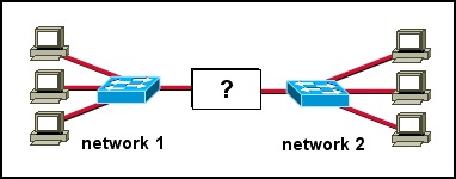
Refer to the exhibit. What type of device is used to connect two networks?
• hub
• router
• switch
• access point

6. It is said that the goal for availability of a communications system is "five-9s". What is meant by this?
• A down time of .00001% is unacceptable.
• A network needs to be available 99.999% of the time.
• Five percent of all network expense covers 99% of user requirements.
• The most critical time for network availability is from 9:00 to 5:00 p.m. five days a week.
• The best time to do maintenance on a network is from 5:00 p.m. to 9:00 a.m. five days a week.

7. What three things are included in a logical topology document? (Choose three.)
• the location of cables, computers, and other peripherals
• the path that the data takes through a network
• the wireless signal coverage area
• the wiring closet and access point locations
• the device names and Layer 3 addressing information
• the location of routing, network address translation, and firewall filtering


8. Which device has the ability to break up broadcast and collision domains?
• repeater
• hub
• router
• switch

9. Why is it important to review the results of an on-site survey report with the customer before beginning the network design?
• to inform the customer of how much time the upgrade will take
• to discuss the implementation schedule for the new equipment
• to verify that the report accurately describes the current network and any plans for expansion
• to layout the new network design and discuss possible equipment upgrades and replacements

10. A client requires a networking device that is capable of expansion to suit growing network demands. What type of device will suit this requirement?
• a networking device with ports that can be activated and deactivated
• a networking device with a modular physical configuration
• a networking device with the ability to be turned off remotely
• a networking device with a cost per port that is as high as possible

11. What does the use of redundant network components supply to a network?
• scalability
• manageability
• compatibility
• reliability

12. What is the benefit for a company to use an ISR router?
• An ISR provides the functionality of a switch, router, and firewall in one device.
• ISRs use a PC operating system for routing traffic, thus simplifying configuration and management.
• An ISR is immune to security attacks by hackers and so replaces all other network security measures.
• ISRs make routing decisions at OSI Layer 7, thus providing more intelligence to the network than do other routers.

13. Which three items are typically found in an MDF? (Choose three.)
• user workstations
• switches and routers • fax machines
• network equipment racks
• the point of presence

• copier

14. What are two advantages of having ISP-managed services? (Choose two.)
• does not require leasing costs for service
• can guarantee up to 99.999% availability
• eliminates the need for data backup
• increases availability of help desk services
• does not require a Service Level Agreement

15. A manufacturing company is in the process of a network upgrade. Which two statements are true about the phases of the upgrade process? (Choose two.)
• Phase 1 is used to determine network requirements.
• Phase 2 includes creating an analysis report.
• Phase 3 is based on an implementation schedule that allows extra time for unexpected events.
• Phase 4 is where prototypes are created and tested.
• Phase 5 includes identifying and addressing any weaknesses in the design.

16. When designing a network upgrade, which two tasks should the onsite technician perform? (Choose two.)
• configure the servers and routers prior to delivery
• upgrade the network operating system and all client operating systems
• investigate and document the physical layout of the premises
• document the final design for approval by the customer
• perform a site survey to document the existing network structure

17. What is the term for the location at the customer premise where the customer network physically connects to the Internet through a telecommunications service provider?
• backbone area
• point of presence
• network distribution facility
• intermediate distribution frame

18.
2
to the exhibit. Which type of twisted pair cable is used between each device?
• A=console, B=straight, C=crossover, D= crossover, E=straight
• A=straight, B=straight, C=straight, D=crossover, E=console
• A=crossover, B=straight, C=straight, D=crossover, E=crossover
• A=console, B=straight, C=straight, D=crossover, E=crossover
• A=console, B=crossover, C=crossover, D=straight, E=straight

19. In what two ways will entering into a managed service agreement with an ISP for a network upgrade affect the costs that are incurred by the customer? (Choose two.)
• Customer IT training costs will increase to enable operation of the new equipment.
• The cost of hardware repairs and support will become the responsibility of the customer.
• Network upgrade and maintenance costs will become predictable.
• Staffing costs will increase because the customer will need to hire additional IT staff to complete the upgrade.
• The company will not need to spend a large amount of money to purchase the equipment upfront.

20. Which type of cable has a solid copper core with several protective layers including PVC, braided wire shielding, and a plastic covering?
• STP
• UTP
• coaxial
• fiber optic

21. What must be added when a network expands beyond the coverage area of the current telecommunications room?
• MDF
• POP
• IDF
• IXP

CCNA Discovery 2: DsmbISP Chapter 2 toets antwoorden / DsmbISP answers exam 2


Working at a Small-to-Medium Business or ISP  4.0 English


DsmbISP Chapter 2 Exam Answers

1. Which two functions are provided by the upper layers of the OSI model? (Choose two.)
• placing electrical signals on the medium for transmission
• initiating the network communication process
• encrypting and compressing data for transmission

• segmenting and identifying data for reassembly at the destination
• choosing the appropriate path for the data to take through the network

2. Which is a function of the transport layer of the OSI model?
• routes data between networks
• converts data to bits for transmission
• delivers data reliably across the network using TCP
• formats and encodes data for transmission
• transmits data to the next directly connected device

3. Which common Layer 1 problem can cause a user to lose connectivity?
• incorrect subnet mask
• incorrect default gateway
• loose network cable
• NIC improperly installed

4. Which three command line utilities are most commonly used to troubleshoot issues at Layer 3? (Choose three.)
• ping
• a packet sniffer
• Telnet
• ipconfig
• Traceroute


5. Which address is used by the router to direct a packet between networks?
• source MAC address
• destination MAC address
• source IP address
• destination IP address

6. What is the correct encapsulation order when data is passed from Layer 1 up to Layer 4 of the OSI model?
• bits, frames, packets, segments
• frames, bits, packets, segments
• packets, frames, segments, bits
• segments, packets, frames, bits

7. What are two goals of the ISP help desk? (Choose two.)
• conserving support resources
• network optimization
• competitive scalability
• customer retention
• sales of network services

8. In what two ways do Level 1 and Level 2 help desk technicians attempt to solve a customer's problems? (Choose three.)
• talking to the customer on the telephone
• upgrading hardware and software
• using various web tools
• making an onsite visit
• installing new equipment
• with remote desktop sharing applications

9. A customer calls the help desk about setting up a new PC and cable modem and being unable to access the Internet. What three questions would the technician ask if the bottom-up troubleshooting approach is used? (Choose three.)
• Is the NIC link light blinking?
• What is the IP address and subnet mask?
• Can the default gateway be successfully pinged?
• Is the network cable properly attached to the modem?
• Is the Category 5 cable properly connected to the network slot on the PC?

• Can you access your e-mail account?

10. A customer calls to report a problem accessing an e-commerce web site. The help desk technician begins troubleshooting using a top-down approach. Which question would the technician ask the customer first?
• Can you access other web sites?
• Is there a firewall installed on your computer?
• What is your IP address?
• Is the link light lit on your NIC card?

11. Which statement describes the process of escalating a help desk trouble ticket?
• The help desk technican resolves the customer problem over the phone and closes the trouble ticket.
• Remote desktop utilities enable the help desk technician to fix a configuration error and close the trouble ticket.
• After trying unsuccessfully to fix a problem, the help desk technician sends the trouble ticket to the onsite support staff.
• When the problem is solved, all information is recorded on the trouble ticket for future reference.

12. What are two functions of the physical layer of the OSI model? (Choose two.)
• adding the hardware address
• converting data to bits
• encapsulating data into frames
• signal generation
• routing packets

13. A customer calls the ISP help desk after setting up a new PC with a cable modem but being unable to access the Internet. After the help desk technician has verified Layer 1 and Layer 2, what are three questions the help desk technician should ask the customer? (Choose three.)
• What is your subnet mask?
• What is your IP address?

• Is the NIC link light blinking?
• Can you ping the default gateway?
• Is the network cable properly attached to the cable modem?
• Is the network cable correctly connected to the network port on the PC?

14. Which scenario represents a problem at Layer 4 of the OSI model?
• An incorrect IP address on the default gateway.
• A bad subnet mask in the host IP configuration.
• A firewall filtering traffic addressed to TCP port 25 on an email server.
• An incorrect DNS server address being given out by DHCP.

15. What are two basic procedures of incident management? (Choose two.)
• opening a trouble ticket
• using diagnostic tools to identify the problem
• surveying network conditions for further analysis
• configuring new equipment and software upgrades
• adhering to a problem-solving strategy
• e-mailing a problem resolution to the customer

16. Which level of support is supplied by an ISP when providing managed services?
• Level 1
• Level 2
• Level 3
• Level 4

17. What is the first step that is used by a help desk technician in a systematic approach to helping a customer solve a problem?
• identify and prioritize alternative solutions
• isolate the cause of the problem
• define the problem
• select an evaluation process

18. A network technician has isolated a problem at the transport layer of the OSI model. Which question would provide further information about the problem?
• Do you have a firewall that is configured on your PC?
• Do you have a link light on your network card?
• Is your PC configured to obtain addressing information using DHCP?
• What default gateway address is configured in your TCP/IP settings?
• Can you ping http://www.cisco.com?

19. An ISP help desk technician receives a call from a customer who reports that no one at their business can reach any websites, or get their e-mail. After testing the communication line and finding everything fine, the technician instructs the customer to run nslookup from the command prompt. What does the technician suspect is causing the customer's problem?
• improper IP address configuration on the host
• hardware failure of the ISR used to connect the customer to the ISP
• bad cables or connections at the customer site
• failure of DNS to resolve names to IP addresses

20. Which layers of the OSI model are commonly referred to as the upper layers?
• application, presentation, session • application, session, network
• presentation, transport, network
• presentation, network, data link
• session, transport, network